On January 13, 2025, Congresswoman Marilyn Strickland and Congressman Blake Moore reintroduced the Basic Allowance for Housing Restoration Act. The press release on strickland.house.gov framed the bill as a fix for a documented housing crisis facing military families. Strickland's office cited Military Family Advisory Network research showing 59.4 percent of active-duty families living off installation pay more than 251 dollars in out-of-pocket housing expenses each month on top of their housing allowance, and nearly a quarter of military families face food insecurity. The bill would direct the Department of Defense to restore the BAH benefit to 100 percent of expected housing costs, reversing a 2015 law that allowed DoD to reduce coverage to 95 percent. 2 Source: See the linked receipts below.
Strickland repeated the housing-affordability framing on March 6, 2025, in a joint release with Senator Raphael Warnock and Congressman Don Bacon pushing to fully restore the servicemember housing allowance. On May 14, 2025, she questioned Army leadership at a House Armed Services Committee hearing about the housing crisis at Joint Base Lewis-McChord, advocating for more on-base housing and raising concerns about cuts to military programs supporting energy resilience. On May 16, 2025, she appeared on Comcast Newsmakers in a segment titled 'Legislation to Address Military Housing Affordability.' On June 4, 2025, she questioned the Secretary of the Army and Chief of Staff about military housing investments, calling for full BAH funding and criticizing the reallocation of military housing funds to the southern border. On June 10, 2025, she hosted a Housing Supply Roundtable in Lacey with regional leaders to discuss federal policy barriers to building more affordable housing.
That 16-month rhetoric arc is documented in eight press releases on strickland.house.gov, all archived locally and verifiable by date and URL. The pattern is consistent: housing is expensive, the federal allowance is not keeping pace, military families are paying the gap out of pocket, and the federal government should help.
On January 9, 2026, the House voted on HR-5184, the Affordable HOMES Act. The bill, sponsored by Representative Erin Houchin of Indiana, would repeal the Department of Energy's authority to set energy conservation standards for manufactured housing and rescind the specific DOE final rule published at 87 Federal Register 32728 on May 31, 2022. That rule had established the first federal energy efficiency standards for new manufactured homes, requiring better insulation, air sealing, duct sealing, HVAC efficiency, and ventilation than the existing HUD code. The Department of Energy had projected the standards would reduce manufactured housing energy use by 30 to 50 percent per home over the life of each unit, depending on climate zone and home configuration. 15 Source: See the linked receipts below.
The vote was House Clerk roll call 119-h-2026-12. It passed 263 to 147. Among House Democrats, 57 voted YEA and 147 voted NAY, a 28 percent Democratic support level. Of the eight Washington Democrats in the House, six voted NAY: Suzan DelBene (WA-01), Rick Larsen (WA-02), Pramila Jayapal (WA-07), Kim Schrier (WA-08), Adam Smith (WA-09), and Emily Randall (WA-06). Two voted YEA: Marilyn Strickland (WA-10) and Marie Gluesenkamp Perez (WA-03).
Three and a half months later, on April 30, 2026, Strickland issued a press release titled 'Strickland Secures 850K for Affordable Housing in Tacoma.' The release announced 850,000 dollars in federal funding to the Tacoma Housing Authority for subsidized housing renovations at Salishan and Hillside Terrace. The release quoted Strickland: 'The South Sound is one of the nation's fastest growing regions and residents are feeling the housing crunch.' Sixteen days earlier, on April 16, 2026, she had questioned Lieutenant General Brian Eifler at a HASC hearing about whether the Basic Allowance for Housing was keeping pace with rising housing costs, under a press release titled 'Strickland Warns Housing Costs Are Outpacing Military Allowance.' 2 Source: See the linked receipts below.
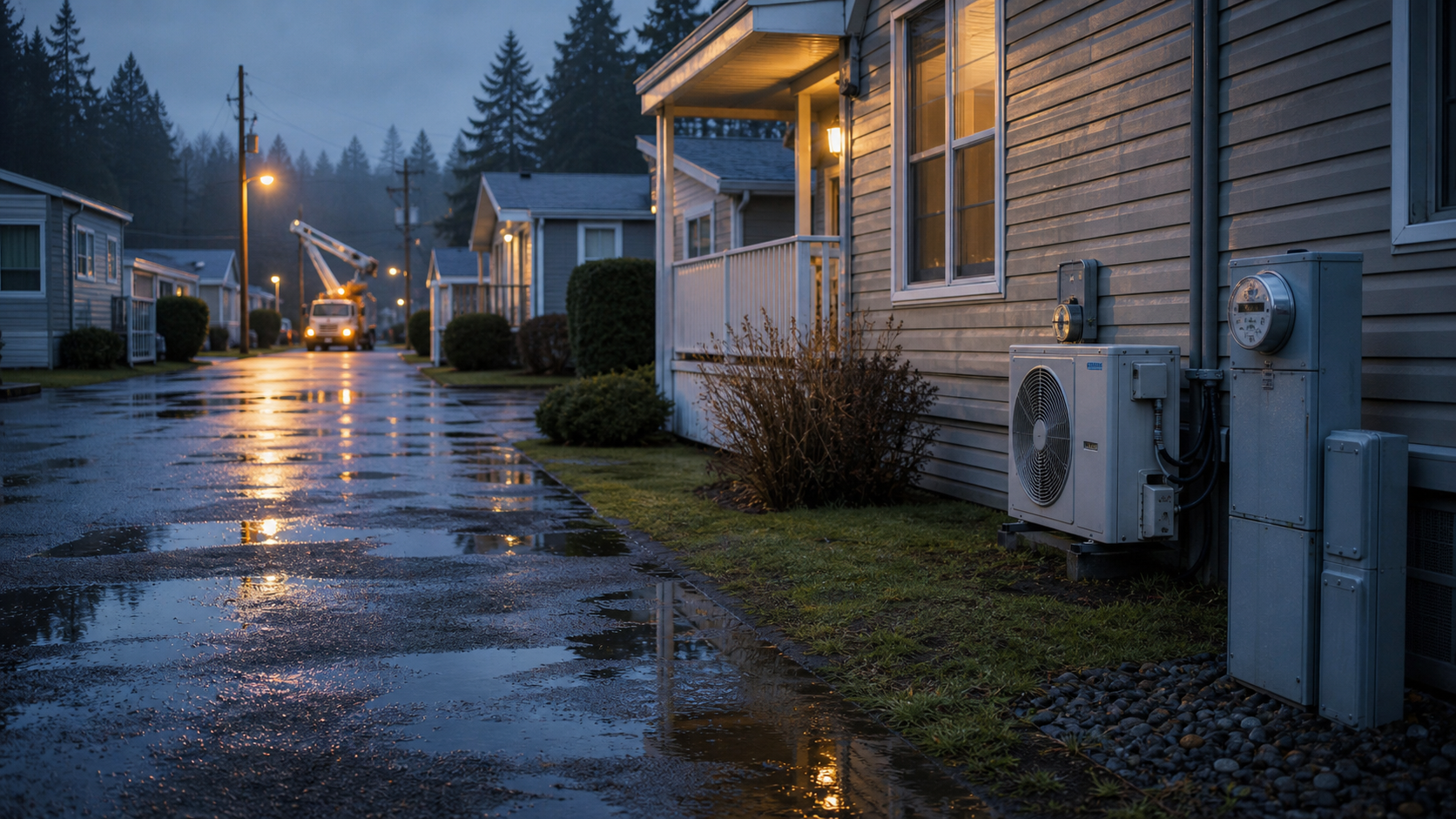
The conditions this vote affects are not abstractions in WA-10. Manufactured housing is concentrated in Spanaway, Parkland, Tillicum, and outlying Pierce County communities where median household incomes sit below the WA-10 average. The Manufactured Housing Institute, the primary trade group lobbying for HR-5184 passage, has consistently argued that the DOE rule would have added upfront cost to new manufactured homes. Department of Energy analysis projected the upfront cost increase would be repaid through energy savings within the first decade of occupancy, after which residents would see net savings for the remaining 30 to 50 year life of the home. The repeal eliminates that long-term savings pathway for every new manufactured home built in WA-10 and nationally.
Manufactured housing residents already pay 50 to 70 percent more per square foot for energy than residents of conventional homes, according to Department of Energy analysis published in the May 2022 final rule preamble at 87 Federal Register 32728. That delta reflects older HUD-code thermal envelopes, less efficient HVAC equipment, and air-leakage rates that exceed International Energy Conservation Code standards used for site-built housing. The DOE rule targeted by the HOMES Act was the first federal effort to bring new manufactured homes closer to site-built housing efficiency. 5 Source: See the linked receipts below.
Strickland for Washington (FEC committee C00732826) received documented real estate industry contributions across the 2023 to 2024 cycle. The Federal Election Commission Schedule A line items show: National Multifamily Housing Council PAC 10,000 dollars across four transactions, maxed at the federal limit. National Association of Realtors PAC 10,000 dollars across five transactions. National Apartment Association PAC 10,000 dollars across three transactions. American Seniors Housing Association PAC 6,000 dollars. CRE Finance Council PAC 1,000 dollars. Plus individual donations: Norman Radow, CEO of RADCO Atlanta multifamily developer, 6,600 dollars across two transactions. Patrick Callahan, principal at Urban Renaissance Group, 5,300 dollars across three transactions. Racquel Russell, Zillow Group Vice President, 4,500 dollars across two transactions. The documented real estate industry total is 53,400 dollars across the cycle. 4 Source: See the linked receipts below.
Strickland sits on the House Armed Services Committee Military Personnel Subcommittee, the committee that has direct jurisdiction over the Basic Allowance for Housing she had been campaigning on restoring. She also serves on the House Transportation and Infrastructure Committee. Committee members can offer amendments during markup, demand section-by-section accountability hearings, and attach housing-affordability conditions to other legislation. The public record contains no Strickland floor amendment, no Strickland markup amendment, and no Strickland standalone bill proposing an alternative path to energy efficiency in manufactured housing after the HOMES Act rescission. She did not have to win the whole HOMES Act vote to take the right side. She only had to vote NAY and align with the rest of the Washington Democratic delegation.
The Strickland-Gluesenkamp Perez alignment on HR-5184 is part of a broader voting pattern. The two are the AIPAC-aligned centrist outliers in the Washington Democratic House delegation. Both crossed party on the HOMES Act in January 2026. Both crossed party on Iran sanctions votes in the 119th Congress, joining a House Democratic minority cluster that included Kim Schrier on some foreign-policy votes. FEC bundled-contribution data places both Strickland and Gluesenkamp Perez among the top AIPAC recipients in the Washington Democratic House delegation.
Truth Engine analysis of Strickland's housing-topic rhetoric across her published statements, press releases, and committee hearings finds 186 housing-tagged statements from 2021 to 2026 with average stated support score 0.58, and an overall housing lip-service score of 0.70, one of the highest topic frequencies among 35 documented rhetoric clusters. Housing is one of Strickland's most-promoted policy themes by frequency. The HOMES Act vote is one of the few documented moments where the vote record diverges sharply from the rhetoric frequency.
What would change this story. If she offered an alternative manufactured-housing energy standard as a markup amendment or standalone bill after the HOMES Act rescission, the 'voted to kill the only federal lever' framing weakens. If the Manufactured Housing Institute's lobbying argument that the DOE rule priced out entry-level new builds is documented in a House Energy Committee record her office relied on, that would justify the vote on a technical basis. If the Strickland-Gluesenkamp Perez mirror pattern fails when extended to other floor votes outside Iran sanctions and HOMES Act, the 'AIPAC-aligned centrist outlier' framing is weaker. The campaign has searched congress.gov, Congressional Record, and committee files for the first two. Neither has surfaced. The third is being tested in the W11 delegation map drop.
The accountability question follows from the record. If a House member spends 16 months campaigning publicly on military housing affordability, holds three House Armed Services Committee hearings on the topic, hosts a Housing Supply Roundtable in her district, and accepts 53,400 dollars from real estate industry PACs and executives in the same election cycle, why does she then vote with 28 percent of House Democrats to repeal the only federal rule designed to make manufactured housing more energy efficient and affordable to operate? The vote, the rhetoric arc, the FEC record, and the WA delegation split are all in the public record. So is the distance between them. WA-10 deserves a representative whose vote matches her press releases on the same topic in the same 16-month window. 1243 Source: See the linked receipts below.