Start with the number that matters. Pierce County's kidney cancer rate is 18.5 cases per 100,000 residents per year, per NCI State Cancer Profiles. The Washington state average is 15.5. That gap of three cases per 100,000 sounds small until you do the multiplication. Pierce County has roughly 940,000 residents. Three extra cases per 100,000 people every year means roughly 28 additional kidney cancer diagnoses each year, statistically above the state baseline. Roughly 28 additional families every year. The National Cancer Institute confidence intervals on Pierce and Washington state do not overlap. Pierce ranks seventh-highest among Washington counties with publicly available data (several counties have suppressed rates due to small case counts). This is not a margin-of-error story.
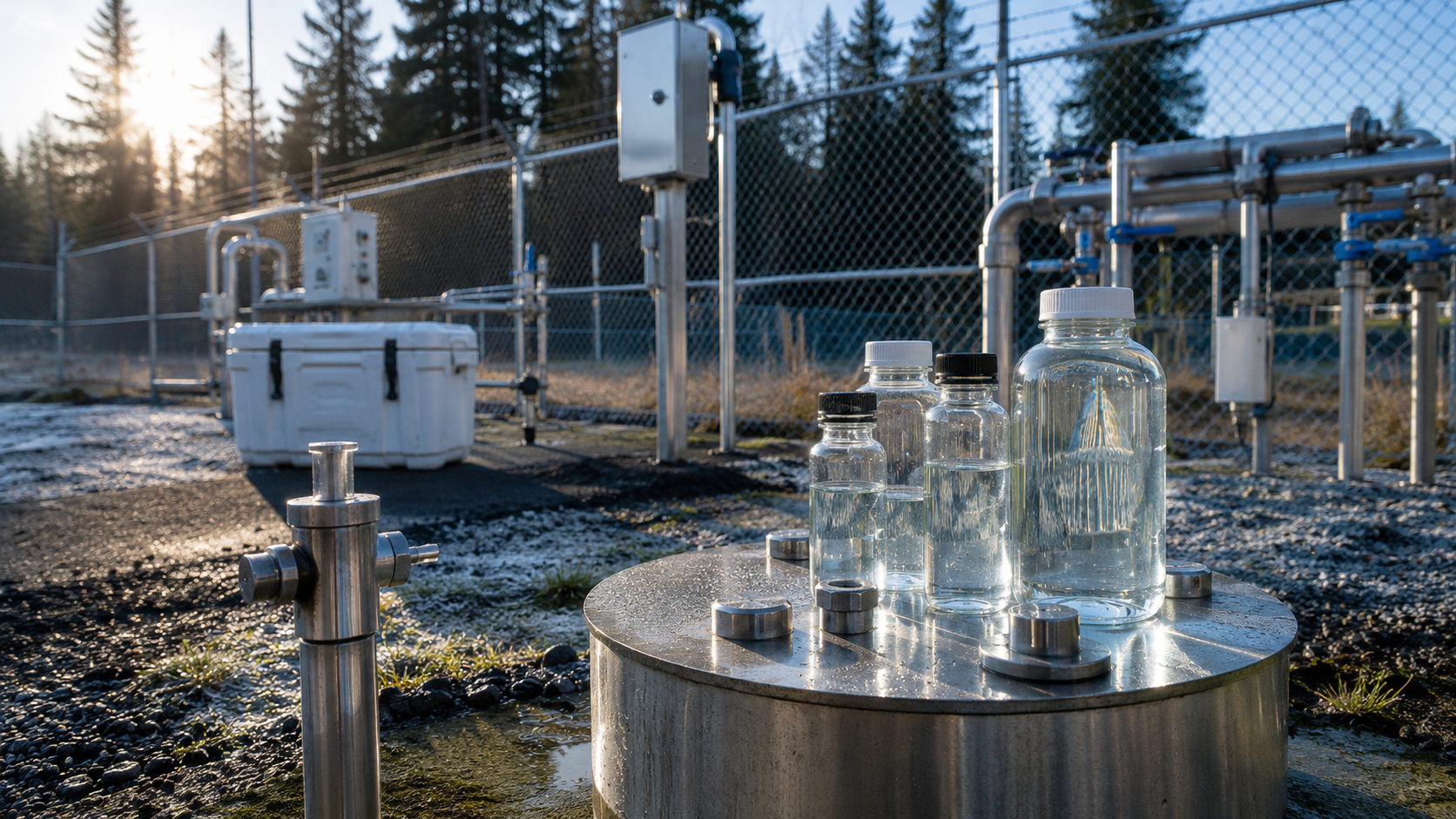
The chemicals doing the damage are called PFAS, short for per- and polyfluoroalkyl substances. PFAS are man-made compounds used for decades to put out aircraft fires on military bases. They do not break down. Once they are in the groundwater, they stay there.
The PFAS plume under Pierce County is documented. The U.S. Geological Survey and the Washington Department of Ecology have mapped contamination flowing out of Joint Base Lewis-McChord, known locally as JBLM. The plume reaches 500 feet underground and pushes northwest into the public drinking-water supply at DuPont, Lakewood, and Parkland, then on into Puget Sound. The source is decades of firefighting foam used by the Army on base.
The Washington Department of Health lists kidney and testicular cancer as known long-term health risks from PFAS exposure. A 2023 peer-reviewed meta-analysis of 15 studies, published in La Medicina del Lavoro and indexed at the National Library of Medicine as PMC10627102, found PFAS exposure raises kidney cancer risk by 18 percent overall and 74 percent at the highest exposure levels, per NCI-indexed medical literature.
The local cost of cleaning up after the Army is already filed in court. Lakewood Water District, the public utility that serves approximately 115,000 people around the western edge of the plume, projects it will spend 377 million dollars over the next 50 years removing PFAS from drinking water, per Pierce County-area water-utility court filings. The district has sued the Department of Defense, the Air Force, and the Army to recover those costs. The Army has not acknowledged responsibility at the scale Lakewood claims.
Now look at the photo ops. The pattern across all three of them tells the story.
“The cleanup got the photo op. The vote went the other way. The contamination is still here.”
Photo op one. On August 30, 2024, Representative Marilyn Strickland announced 950,000 dollars in federal Community Project Funding, the program members of Congress use to direct federal money to specific projects in their districts. Source: Strickland.house.gov clean-water announcement. The money was for a new clean-water well in Lakewood. Standing at the Scott Granular Activated Carbon Wellsite, she said: 'All communities deserve access to clean water. It's that simple.' The press release is on her House website. The grant she announced covers about a quarter of one percent of the projected 50-year cleanup cost the same utility is filing suit to recover.
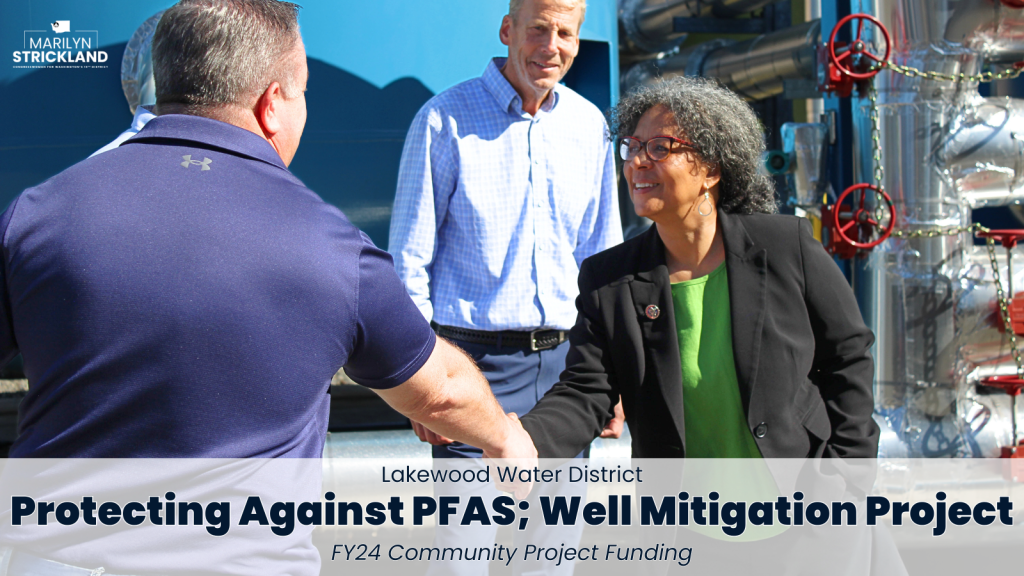
Photo op two. One year later, in September 2025, she toured Aquagga, a Tacoma-based startup that destroys PFAS using a process called Hydrothermal Alkaline Treatment. The U.S. Department of Defense has funded Aquagga's demonstration work. The Tacoma-Pierce County Economic Development Board had already featured the company as a regional innovation success. Strickland's office described Aquagga as a company 'fighting against the spread of these dangerous toxins in local waterways' in a published press release.
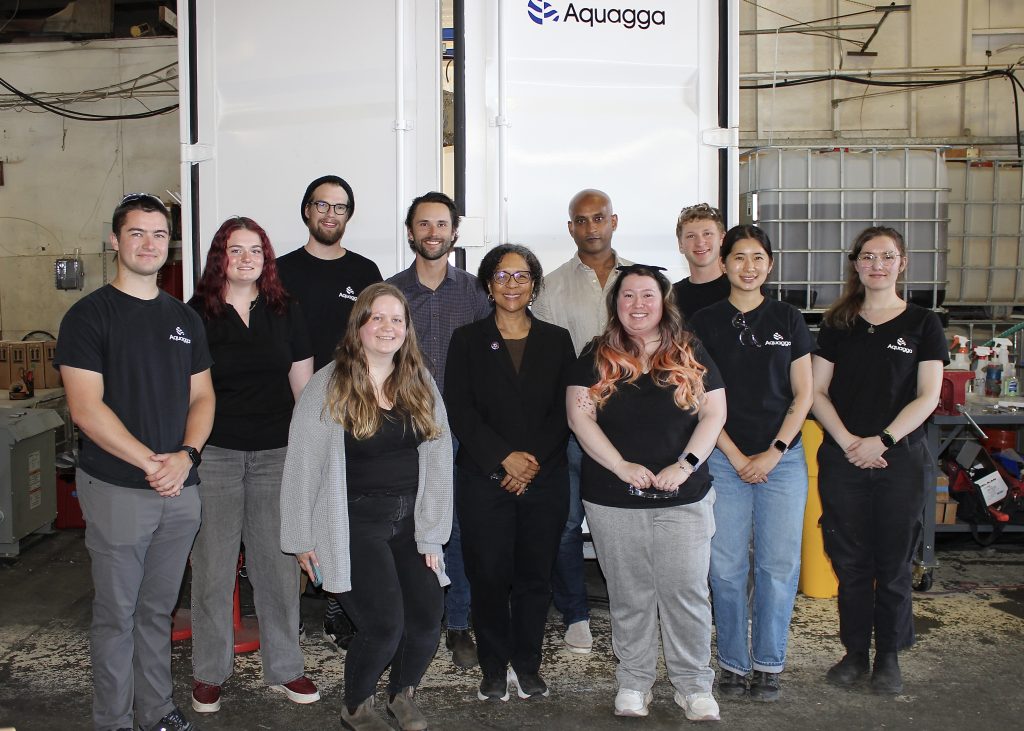
Aquagga's work is real and important. The team is doing the cleanup engineering the federal government has refused to fund at the scale the contamination demands. None of what follows is a critique of Aquagga or its people. The critique is of the political framing built on top of their work, by an office that has the authority to act on the source and has not.
Photo op three. The Steilacoom Garrison Springs Creek restoration. On November 30, 2023, her office announced 1.5 million dollars in federal Community Project Funding for creek restoration in Steilacoom. The grant funded the Garrison Springs Creek and adjacent shoreline cleanup work that is now in process. The grant did not appear out of nowhere. Her office requested it, drafted the project description, submitted it through the House Appropriations Committee Community Project Funding process, secured the appropriation, and then announced it with a photo. She has continued to reference the Garrison Springs project in subsequent statements about her record on environmental cleanup in WA-10.
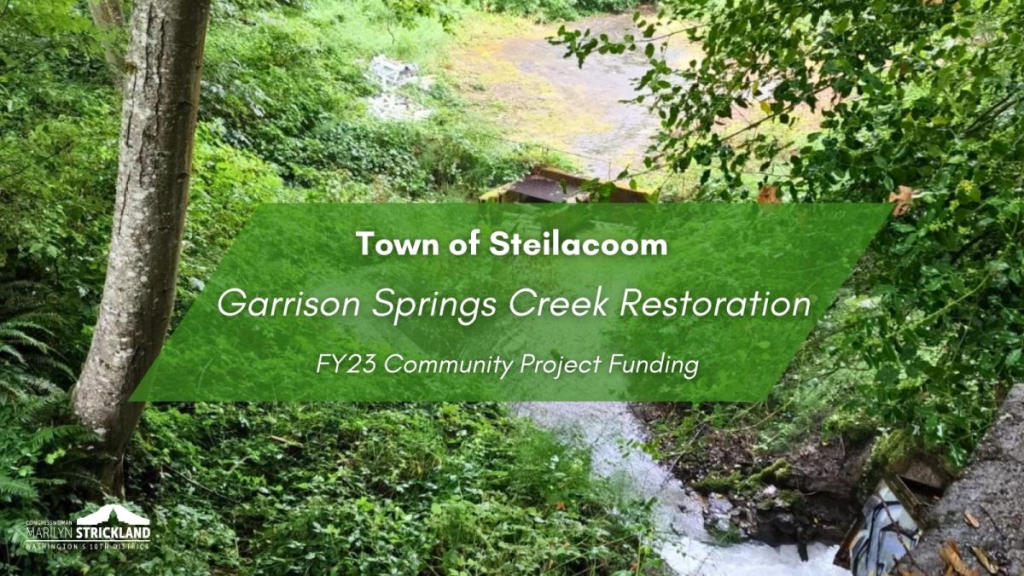
Garrison Springs sits in Steilacoom, which drains through the Chambers Creek watershed. JBLM occupies approximately 18 percent of that watershed, per Pierce County watershed records. Whether PFAS contamination from JBLM has reached the Garrison Springs corridor and lower Chambers Creek is a question the public record has not yet answered. The campaign has submitted a public records request to Washington Department of Ecology for PFAS monitoring data in the Chambers Creek watershed downstream of JBLM, and will update this story when those records are received. What is not in dispute: the restoration money she requested funds a creek and shoreline cleanup. The upstream PFAS source at JBLM is not in the scope of that grant.
A note on what source control means here, because the timeline matters. The FY2020 National Defense Authorization Act required the U.S. Department of Defense to stop purchasing new firefighting foam containing PFAS, with a phase-out deadline of October 1, 2024 that was later extended. For about five years, that ban was the federal source-control lever. Environmental Working Group analyses criticized the FY2026 NDAA's PFAS posture, but Watchtower is not treating the AFFF phase-out or cleanup-funding claim as release-ready until the exact public-law section language is attached. Source control is the regulatory question of whether the federal government will allow new PFAS to enter the ground at military installations. The plume already under WA-10 is the legacy. Both fights are on the same committee desk.
And the plume is not just a legacy of the past. JBLM has documented PFAS discharge events inside its hangar fire-suppression systems, on both the Army aviation side (Gray Army Airfield, including the 1-229th Aviation Regiment area) and the McChord Air Force side. AFFF (aqueous film-forming foam) hangar systems are designed to dump foam in a fire emergency. They have also dumped foam in non-fire events, false alarms, equipment failures, and unscheduled tests. Washington Department of Ecology cleanup site record 17189 catalogs the JBLM PFAS investigation. The full event log requires a Freedom of Information Act request to the U.S. Army Environmental Command and Air Force Civil Engineer Center; the campaign is filing that request. The point is straightforward: even after a federal ban on new foam purchasing, foam already installed in fire-suppression systems can still discharge. That is a maintenance and decommissioning fight. That fight also sits on the House Armed Services Committee.
Three months after the Aquagga photo op, on December 10, 2025, Strickland voted YEA on the FY2026 National Defense Authorization Act, the annual defense spending bill known as the NDAA. House Clerk Roll Call Vote 320 passed 312 to 112. The vote record is on clerk.house.gov. Strickland voted against an earlier House-passed version in September (Roll Call 262, 231-196) when Speaker Johnson inserted partisan floor amendments into the bipartisan committee product; she was among 192 House Democrats who voted NAY, including HASC Ranking Member Adam Smith. Source: House Clerk Roll Call 262, clerk.house.gov/evs/2025/roll262.xml. She voted yes in December when the bicameral compromise restored provisions she cited publicly: $80 million for a new JBLM fire station and $55 million for a Command and Control Center. Her December statement does not mention PFAS.
Environmental Working Group analyses published in August 2025 and December 2025 criticized the NDAA's PFAS provisions and cleanup posture. Watchtower is keeping the specific AFFF-deadline and cleanup-dollar claims out of the hard release frame until the exact enacted-law section and authorization-table language are attached. The same enacted law added Section 317, requiring DoD to provide alternative water supplies to households contaminated by DoD PFAS activity. PFAS has been detected at hundreds of military installations nationwide. More than 30 Department of Defense sites continue serving drinking water above U.S. Environmental Protection Agency health limits.
Strickland sits on the House Armed Services Committee, the committee that writes the NDAA. Committee members have specific tools the rest of the House does not. They can offer amendments at the markup stage, before the bill comes to the floor. They can attach conditions to procurement authorization, including conditions that require the Army to fund cleanup as a condition of getting new equipment. They can demand section-by-section accountability hearings on Army cleanup obligations.
Strickland has introduced PFAS legislation. In both the 118th and 119th Congresses, she co-led a bipartisan bill directing the Secretary of Defense to establish a compensation fund for military firefighters who developed illness from PFAS exposure during their service: H.R. 705 in the 119th Congress, co-led with Representative Lawler (R-NY). That bill matters and it is not the same fight as what this story documents. Compensating personnel already sickened is a different intervention from stopping the source of contamination. A search of Congress.gov for legislation sponsored by Representative Strickland targeting JBLM-specific PFAS source control, DoD cleanup cost recovery for off-base water systems, or civilian drinking-water remediation returns no results. The search link is in the receipts. Run it yourself.
Commencement Bay in Tacoma has been on the Environmental Protection Agency Superfund National Priorities List since September 8, 1983, with documented industrial contamination across multiple operable units and active cleanup zones. The Puyallup River has recorded the second-highest polychlorinated biphenyl, or PCB, concentrations in juvenile Chinook salmon tissue of any river in the Puget Sound region, per Washington Department of Fish and Wildlife monitoring data (WDFW Report FPT 16-02, O'Neill et al. 2015). The Duwamish ranks first; Snohomish and Nisqually follow. All four exceeded the 2,400 ng/g lipid fish health threshold. Fish-consumption advisories affect Puyallup Tribe treaty fishing rights. These are not abstractions. They are the conditions the NDAA vote affected.
The cleanup work also became part of the region's public economic-development record. The Tacoma-Pierce County Economic Development Board, known locally as EDB, gave out its 2026 Excellent 10 awards in the same cycle that recognized both Aquagga's Tacoma per- and polyfluoroalkyl substances pilot AND the Strickland Fellowship for Career Pathways, a University of Washington Tacoma workforce program named in her honor. EDB is the awarding body. The fellowship bears her name. The same award cycle recognized the cleanup work. The public-accountability question is how cleanup work, workforce branding, and federal oversight connect. UW Tacoma says the fellowship 'honors her legacy of workforce development.'
What would change this story. A documented Strickland amendment opposing the PFAS provisions of the FY2026 NDAA, found in the Congressional Record or in House Armed Services Committee markup transcripts, would weaken the 'sat on the committee and did not use it' framing. A confirmed explanation for Pierce County's elevated kidney cancer rate independent of PFAS exposure would weaken any causal inference beyond the rate comparison. A direct citation to the specific NDAA section and its exact language on the AFFF phase-out deadline extension, independent of Environmental Working Group analysis, would upgrade that core claim from B-grade summary to A-grade primary text. As of publication, none of those three have surfaced. The campaign is publicly inviting the office to provide any of them.
The accountability question is plain. Local and federal leaders can coordinate three photo ops, a workforce fellowship, startup promotion, and regional branding around PFAS cleanup. They can request the appropriation, draft the project description, submit it, secure it, and announce it. That public record still leaves a source-control question for the Armed Services Committee seat. Voters elected her to ask that question on the committee that decides the answer. The vote on December 10, 2025 is part of the record voters can evaluate. The cleanup got repeated public attention; her post-vote statement emphasized JBLM projects and did not mention PFAS. The contamination record and county health data deserve a public accountability plan.
The photo at Lakewood, the photo at Aquagga, the photo at Garrison Springs, the Economic Development Board cleanup-economy branding, the Strickland-named workforce fellowship, and the YEA vote on December 10 are all in the public record. So is the distance between them. Washington's 10th deserves a representative who can explain that distance, and who uses a seat on the Armed Services Committee to connect cleanup visits with source-control accountability.