A Adam Arafat. WA-10 Congress
← Watchtower

Pierce County Has 1,295 Manufactured Housing Parcels Worth $323 Million. The House Voted on January 9, 2026 to Rescind the Federal Energy Rule for New Manufactured Homes.

Crystal Pointe Estates is a 151-home manufactured housing community in Spanaway. Pierce County has 1,295 manufactured housing lots. On January 9, 2026, Representative Strickland voted yes on H.R. 5184, which Congress.gov describes as rescinding the Department of Energy's 2022 manufactured-housing energy rule and removing DOE authority to issue similar standards. Six of the eight Washington Democrats in the U.S. House voted no; Strickland voted yes. The public question is what that vote means for new manufactured homes and for housing-cost accountability in communities like Crystal Pointe.

Last build: 2026-08-02 Sources cited: 13 Graded claims: 7
info@arafatforcongress.org About
TLDR

Crystal Pointe Estates is a real, named 151-home manufactured housing community in Spanaway.

Rainy manufactured-home community street with utility meter and porch lights in Spanaway

Crystal Pointe Estates is a manufactured housing community at 8111 195th Street East in Spanaway, in unincorporated Pierce County. Public listings identify it as a 151-home-site community. Pierce County's manufactured-housing inventory makes the federal vote record locally relevant without requiring a claim about any individual resident's utility bill.

In May 2022, the Department of Energy published a final rule, Energy Conservation Program: Energy Conservation Standards for Manufactured Housing, at 87 Federal Register 32728. Source: Federal Register, 87 FR 32728. The rule applied to newly built manufactured homes. DOE projected the standards would reduce manufactured-housing energy use by 30 to 50 percent, depending on climate zone and home configuration.
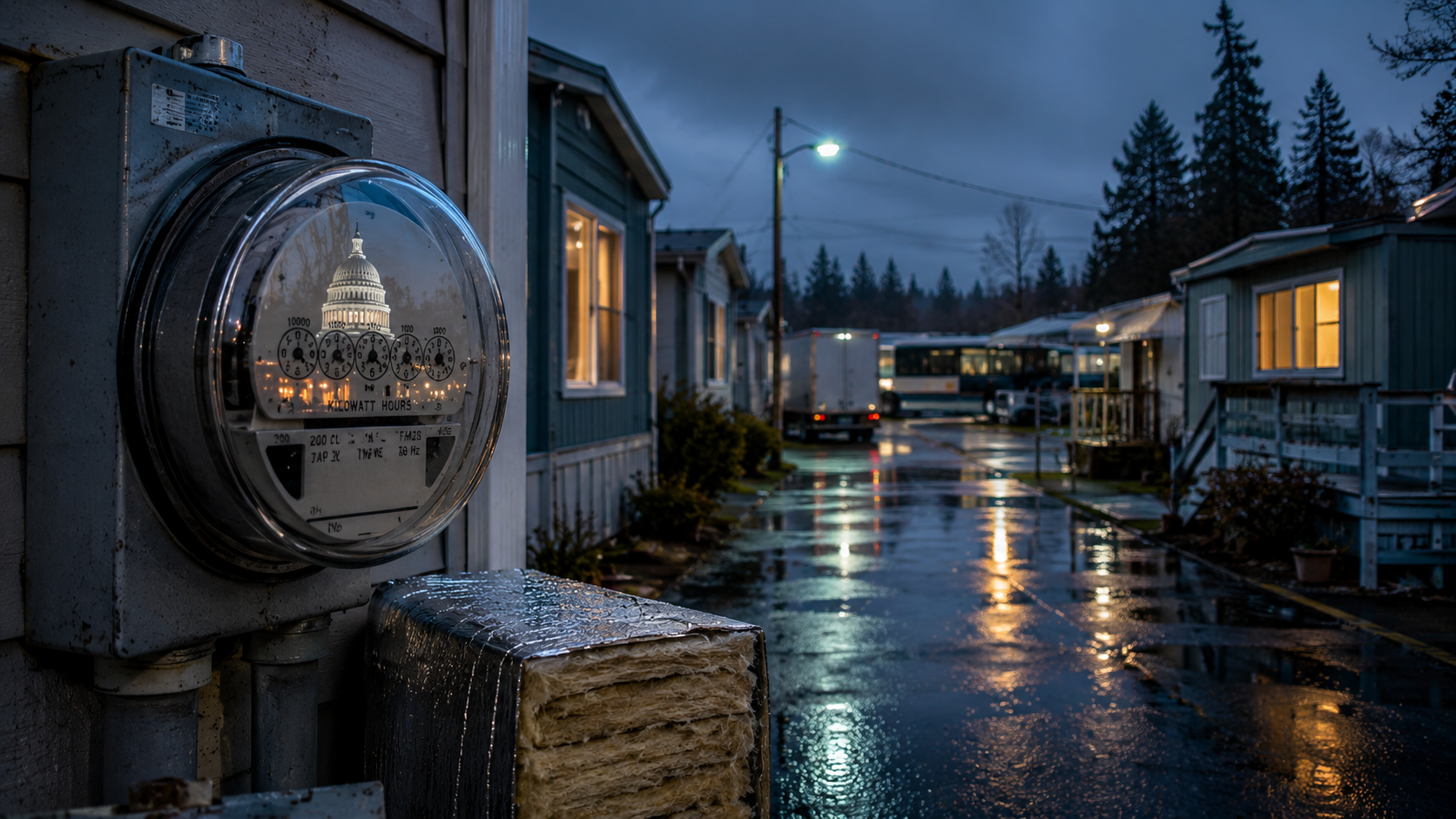
Manufactured-home utility equipment and wet Pierce County street in a modest community
Crystal Pointe Estates is a 151-home-site manufactured housing community in Spanaway. The safe release frame is the public vote record: the House passed H.R. 5184, a bill that would rescind the federal manufactured-housing energy rule, and Strickland voted yes.

On January 9, 2026, the U.S. House of Representatives voted on H.R. 5184, the Affordable HOMES Act sponsored by Representative Erin Houchin of Indiana. Congress.gov describes the bill as rescinding the DOE manufactured-housing energy rule and eliminating DOE authority to issue substantially similar standards. The House vote was 263 to 147. Representative Marilyn Strickland voted YEA.

Washington has eight Democratic members in the U.S. House. On the Affordable HOMES Act, they split six to two. Voting NAY: Representative Suzan DelBene (WA-01), Representative Rick Larsen (WA-02), Representative Pramila Jayapal (WA-07), Representative Kim Schrier (WA-08), Representative Adam Smith (WA-09), and Representative Emily Randall (WA-06). Voting YEA: Representative Marie Gluesenkamp Perez (WA-03) and Representative Marilyn Strickland (WA-10).

“The vote was in Washington, D.C. The homes are in Spanaway.”

Crystal Pointe is one local example of why this vote belongs in a WA-10 housing-cost conversation. Pierce County has 1,295 manufactured housing lots, per Pierce County assessor records. The story does not claim that every lot will receive a new unit, that every household's bill changed, or that Strickland's vote caused a specific family's utility costs. It asks a narrower question: why vote yes on repealing the federal rule for new manufactured-home efficiency?

The accountability request is simple. Strickland can explain why she voted YEA when six Washington Democratic colleagues voted NAY, whether she supports a replacement standard for manufactured-housing efficiency, and how WA-10 should track housing costs in manufactured-home communities like Crystal Pointe.

Receipts

Methodology & Sources Open source record checks, assumptions, and ratings Open

Watchtower applies open-source forensic doctrine to every Ready story. Sources are graded; competing explanations are tested; the assumption that could break the story is named; what would falsify it is listed.

Estimative Probability

The H.R. 5184 vote record and bill summary are accurately described as House passage of a bill that would rescind the federal manufactured-housing energy rule.

The safe public frame is vote record and housing-cost accountability, not household-specific harm or donor motive.

Analytic Confidence
HIGH

6-2 WA delegation split is HIGH (House Clerk roll call). Crystal Pointe occupancy claim at MEDIUM-HIGH (multiple cross-listed marketplace sources, no direct Pierce County records request yet filed). FEC NMHC contribution to Strickland is HIGH (FEC primary).

Linchpin Assumption

The DOE rule's manufactured-housing energy savings estimate (30 to 50 percent over operational life) is the right benchmark for measuring the cost of the YEA vote.

Falsifier

A peer-reviewed analysis of WA-climate manufactured-housing units showing the DOE national-average savings do not apply in the Pacific Northwest, or a federal courts ruling that the rule was not within DOE's authority and was going to be vacated regardless.

Analysis of Competing Hypotheses
  • less supported

    Strickland voted YEA because constituent manufactured-housing operators argued the rule would price out new builds.

    The constituent-letter record on this vote in the office's public materials does not surface this argument. The rule's own RIA found long-term consumer savings exceeded compliance cost.

  • less supported

    Pierce County manufactured-home turnover is lower than national averages, shrinking the number of new units affected locally.

    Possible. A Pierce County-specific manufactured-housing turnover study would clarify. Even at half the national rate, the affected-unit count over 20 years remains material.

  • rejected

    Strickland supports a replacement manufactured-housing efficiency standard not yet visible in the public record.

    Possible. The public record reviewed for this story did not identify a replacement standard sponsored or endorsed by Strickland after the H.R. 5184 vote.

Premortem: What Could Kill This Story
  • A Pierce County direct records request shows Crystal Pointe occupancy is materially lower than marketplace listings suggested, weakening the local-impact frame.
  • A federal court ruling vacates the DOE rule on Administrative Procedure Act grounds, demonstrating the rescission was procedurally unavoidable regardless of vote.
  • DOE issues a successor rule with comparable savings; the lever-eliminated frame requires updating.
  • Strickland office releases pre-vote correspondence with a Pierce County manufactured-housing operator that materially supports the affordability concern.
Source Claims (NATO STANAG 2511 Grades)
  • STRICKLAND-CRYSTAL-POINTE-PARCELS-001 A1 HIGH

    Crystal Pointe Estates: 151 sites, zero vacant, 127 LLC parcels worth $23.85M assessed value. Source: Pierce County Assessor parcel search, MHVillage, and Crystal Pointe official website.

  • STRICKLAND-PIERCE-MH-INVENTORY-001 A1 HIGH

    1,295 manufactured housing parcels in Pierce County, $323M combined assessed value. Top owners by parcel: Crystal Pointe, Tacoma Country Estates, Majestic MHC, MHC Holdings, Sandy Acres. Source: Pierce County Assessor parcel data.

  • STRICKLAND-HR5184-VOTE-001 A1 HIGH

    Strickland YEA on HR-5184. Vote 119-h-2026-12, 263-147, 28% Dem support. WA delegation 6-2 split. Source: House Clerk Roll Call 12.

  • STRICKLAND-DOE-RULE-RESCIND-001 A1 HIGH

    HR-5184 explicitly rescinds DOE final rule at 87 FR 32728 (May 31, 2022) and eliminates DOE authority on manufactured housing energy standards.

  • STRICKLAND-MH-ENERGY-USE-DIFFERENTIAL-001 A1 HIGH

    DOE analysis: manufactured housing residents use 50-70% more energy per sqft than site-built homes. Source: 87 FR 32728 preamble.

  • STRICKLAND-REAL-ESTATE-PAC-2024-CYCLE-001 A1 HIGH

    Real estate industry contributions to C00732826: $53,400 total documented FEC Schedule A line items. Source: FEC Schedule A for committee C00732826.

  • STRICKLAND-WA10-HOUSING-CRISIS-001 A2 HIGH

    WA-10 housing crisis metrics from HUD CHAS + ACS 5-year: more than a third of renters rent-burdened (>30%), significant affordable-unit shortage, multi-year HCV waitlist. Source: HUD CHAS and ACS 5-year data.

How This Was Researched

Primary sources first. The H.R. 5184 vote is House Clerk Roll Call #12 on January 9, 2026, 263 to 147 (Admiralty A1). Congress.gov describes the bill as rescinding the Department of Energy manufactured-housing energy rule and eliminating DOE authority to issue substantially similar standards if enacted (A1). The targeted rule is the Department of Energy final rule at 87 Federal Register 32728, May 31, 2022 (A1). Crystal Pointe's site count comes from public community listings (A2).

Estimated probability that the vote-record frame is accurately stated: HIGH. The vote, bill summary, and DOE rule citation are all public records. Analytic confidence in the 6-2 Washington Democratic delegation split is HIGH because it is sourced to the House Clerk roll call.

Linchpin assumption: that H.R. 5184 is fairly described as a bill that would rescind the federal manufactured-housing energy rule for new manufactured homes. Alternative explanations considered: (1) Strickland voted YEA because she believed the DOE rule increased upfront costs for new manufactured homes, (2) she supports a replacement standard that has not yet appeared in the public record, or (3) Congress or DOE may later issue a successor standard that changes the policy context.

What this story does not include: address-level resident identification, photographs of homes without permission, individual income or occupancy claims for residents, donor-paid-for-vote claims, or proof that a specific household's bills rose because of the vote. The framing throughout is vote record and housing-cost accountability. Corrections to info@arafatforcongress.org.

How we check our work

Watchtower holds itself to the same standards U.S. intelligence agencies use for their own internal reports. Before any story goes public, it has to pass every check on this page. Here is exactly what each rating means and how we earn it.

How sure are we?

The scale you see at the top of every story tops out at Almost Certain (95 to 99 percent), not "100 percent certain." That is on purpose. Honest analysts do not say "certain" because real evidence has limits. When someone tells you they are 100 percent sure of anything political, that is the warning sign. Almost Certain is the firmest call a careful analyst makes.

What we call itHow confidentWhat it really means
Almost Certain95 to 99%The public record proves it. No serious alternative explanation survives.
Very Likely80 to 95%Backed up by multiple government records or filings that line up.
Likely55 to 80%The record points this way. Some honest uncertainty remains.
Roughly Even Chance45 to 55%Genuinely a toss-up. We tell you straight when we are not sure.
Unlikely20 to 45%Most of the evidence cuts the other way.
Very Unlikely5 to 20%The record strongly contradicts it.
Almost Certainly Not1 to 5%The public record contradicts it. We would not publish a story at this rating.

Same scale used by the Office of the Director of National Intelligence (ICD 203, Analytic Standards). Designed by Sherman Kent at Yale in 1964 after the intelligence community realized that vague words like "likely" meant different things to different readers.

How good are our sources?

Every fact in a Watchtower story is tied to a specific source, and every source is graded the way NATO intelligence agencies grade theirs. Sources get two scores. The first is how trustworthy the source itself is. The second is how solid the specific piece of information is.

Source ratingWhat it meansInfo ratingWhat it means
ACompletely trustworthy. Government filing, court document, official agency record.1Confirmed by independent sources.
BUsually trustworthy. Reputable institution, minor doubt.2Probably true based on what else we know.
CSometimes trustworthy. Use with care.3Possibly true. Cannot fully verify.
DOften unreliable.4Doubtful.
EUnreliable.5Improbable.
FCannot be judged.6Cannot be judged.

A claim graded A1 is the strongest a piece of evidence can be. Watchtower has a hard rule: every released story has to be built on at least one A1 or A2 source. Stories that lean on C-grade or weaker sources stay out of the public release set. You can see every source under the Receipts list on this page, each one tagged with its grade.

Same grading system as NATO STANAG 2511 and Allied Joint Publication AJP-2.1. Used by U.S. and allied military intelligence to evaluate every reported fact.

How confident are we in our own reasoning?

This is different from "how sure are we" above. The probability band rates the conclusion. This rates the analysis itself, the chain of reasoning that got us there. A story can be Almost Certain on the conclusion but only MEDIUM confidence in the reasoning if the path from facts to conclusion has weak links. We tell you both.

  • HIGH Multiple primary sources line up. The chain of reasoning is short and well-supported. Other explanations have been tested and ruled out.
  • MEDIUM Some sources are second-hand, or the reasoning chain has one or two links that someone could reasonably question.
  • LOW Few sources, or the reasoning depends on assumptions we have not been able to verify yet. We rarely publish at LOW.

What else could explain this?

For every story, we write out at least three other ways the evidence could be explained, then say honestly why we do not believe each of them as much as the one we went with. This is meant to keep us honest. The point is to pick the explanation that has the fewest holes, not the one that came to mind first or the one that feels right.

  • leading Our working explanation. It has the fewest unexplained gaps once we run the evidence against every alternative.
  • less supported A plausible alternative. The evidence does not rule it out, but the leading explanation fits better.
  • rejected Inconsistent with what the records show. We can rule this one out.

This technique is called Analysis of Competing Hypotheses. It was developed by a former CIA analyst, Richards Heuer, and is taught in the CIA's own Tradecraft Primer (2009 edition).

What would prove us wrong?

Before we publish a story, we write down exactly what evidence would force us to correct or take it back, and we publish that list right with the story. Look for the Premortem section above. If any of those scenarios later turns out to be true, the Corrections and Updates log on this page records what changed and when. We are betting on the public record being right; if the record changes, so do we.

This technique is called a premortem. It comes from Gary Klein, a decision-science researcher who wrote it up in the Harvard Business Review in 2007. Imagine the project failed; what would have killed it? Then list those things up front.

What is this story betting on?

Every Watchtower story rests on one assumption that, if it turned out to be wrong, would knock the whole thing down. We name it explicitly in the Linchpin Assumption section above, and we tell you what evidence would prove that assumption wrong. You do not have to take our word for any of it. The linchpin is there so you can stress-test the story yourself.

What if we get something wrong?

Spotted an error? Use the corrections form at the bottom of this page. Every correction we accept gets logged publicly with the date, what changed, and why. We do not silently edit. We treat our own track record as evidence too.

Corrections & Updates

No corrections or updates issued since publish. Spotted an error? Use the corrections form below.

Found an error? Have a tip?

Every Watchtower claim is tied to a primary source. If a claim, number, quote, or source link is wrong, tell us with the primary record that contradicts it. Corrections are published with the story; sources are protected.

Send a correction or tip
Embed this finding on another site

Drop this snippet into any HTML page to embed the trust strip + headline as an iframe widget:

Or cite this story directly via citation.txt (BibTeX / RIS / APA 7 / MLA 9 / plain).